The dry-out is the small number. The interruption is the big one.
For a retail tenancy, a clinical space, an aged care wing, a classroom block or a commercial kitchen, the restoration invoice is rarely the cost that matters. The cost that matters is every day the space can't be used — and a dry-out that finishes on a date instead of a reading can double it.
We scope to the standard, document to the standard, and give you the file that stops a scope dispute or a later claim denial from becoming your problem.
The questions that matter on a commercial job, and our answers.
| Question | Our answer |
|---|---|
| What standard is the work performed to, and will I receive documentation showing compliance? | AS-IICRC S500:2025, ANSI/IICRC S520, ANSI/IICRC S700 as applicable. Yes — the full file at completion, sample available before engagement. |
| What dry standard will you use for each material, and how will you set it? | From reference readings on the same material in an unaffected part of your building. Set on day one, stated in the report. |
| How many moisture readings, where, and will I get the daily logs? | Mapped outward from the source until readings match reference. Logged daily. Logs are yours. |
| What category and class have you assigned, and why? | Stated on the report before the scope, with reasoning. The scope has to justify itself against it. |
| Who signs off completion, and against what evidence? | The Managing Director, against the daily log showing dry standard reached. |
| If materials haven't reached dry standard in the quoted period, who carries the cost of extended drying? | TBC — commercial terms to confirm. The daily log shows exactly how many days were needed and why. |
| Will reinstatement begin only after documented clearance? | Yes. We hand over to your builder with the completion record. Nothing is closed up before the structure is verified dry. |
What a thorough dry-out includes
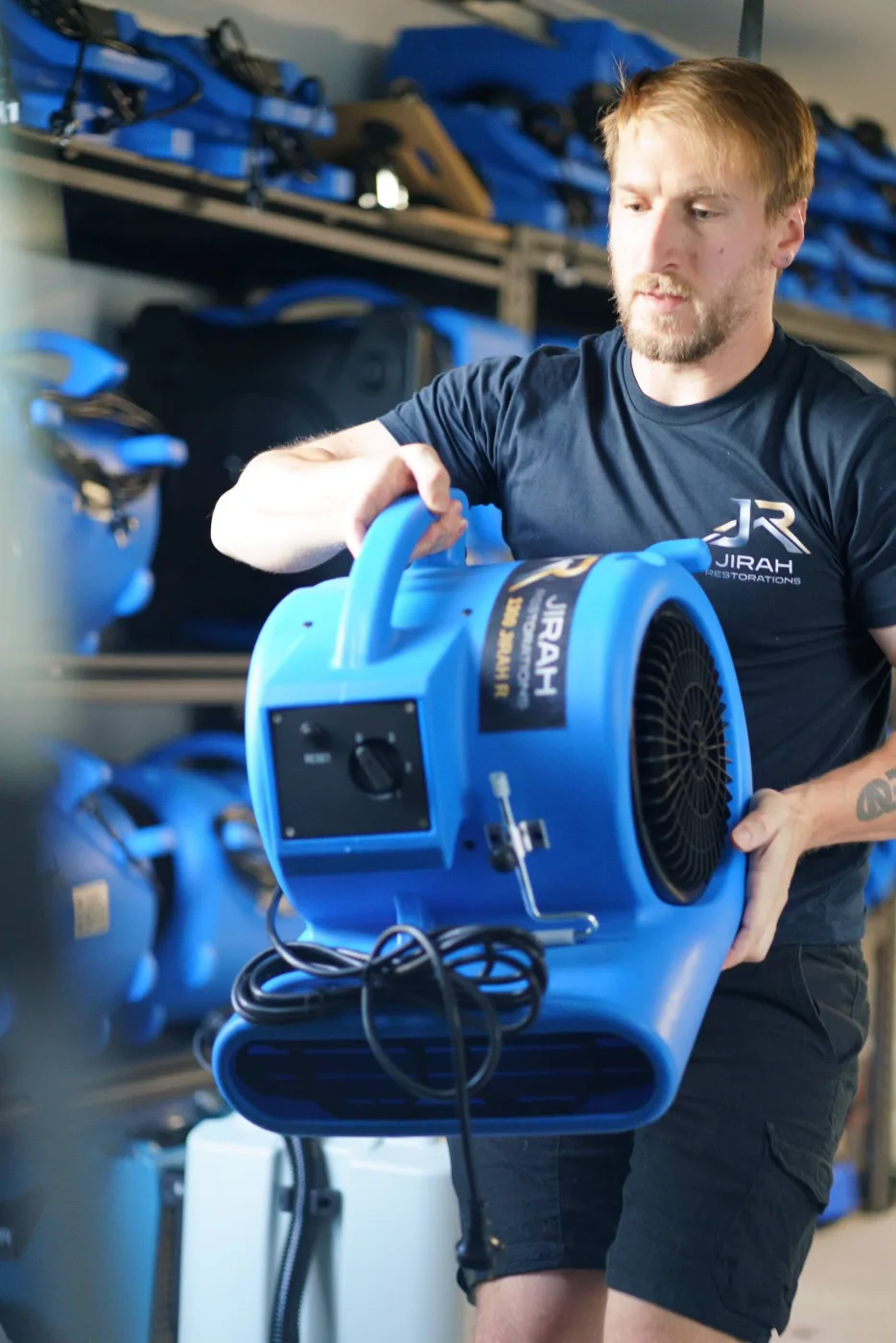
A thorough commercial dry-out includes moisture mapping past the visible area, enough equipment for the class of loss, daily readings, a defined dry standard, clearance before reinstatement, and a dated evidence file.
Each of these protects you later. Moisture left in a cavity or slab isn't visible on the day the equipment leaves — the readings are what confirm the structure is genuinely dry.
When drying stops short, the signs can appear months later: odour and cupped flooring at three to nine months, and cavity mould at nine to twenty-four — by then needing containment, negative air, occupant relocation and the reinstatement done a second time. A complete file also protects the claim, because it shows the property was dry on a specific date.
Working around a business that's still running
Out of hours.
Assessment, equipment placement and monitoring scheduled outside trading or operating hours where the site requires it.
Containment in occupied space.
Mould and Category 3 work sealed and filtered so adjacent areas stay in use.
Staged works.
Large footprints dried and remediated in zones so the whole site isn't offline at once.
Site induction and WHS.
Our crews work to your site requirements. WorkCover Queensland insured.
Mould in a workplace is a WHS matter
Under Queensland's Work Health and Safety Act, a person conducting a business or undertaking has a duty to manage risks to health — and mould in a tenancy is one of them. A documented assessment, a documented remediation and a documented clearance are how that duty is shown to have been met.
The Jirah Commitment
Jirah Restorations makes seven commitments on every job, residential or commercial, insured or private.
- 1Attendance. At the time agreed. Delay notified to client and occupant before the scheduled time.
- 2Full assessment. The whole affected area, including concealed moisture.
- 3Disclosure of findings. All findings documented, including damage outside reported scope and any pre-existing condition.
- 4Disclosure of limitations. Non-restorable materials identified before works commence, with reason.
- 5Completion against a standard. Equipment deployed until documented dry standard is reached, verified daily. Works to AS-IICRC S500:2025, ANSI/IICRC S520 and ANSI/IICRC S700 as applicable.
- 6Occupant notification. Occupants, including tenants, contacted directly prior to attendance.
- 7Equal priority. Set by urgency and risk, not claim value.
Director accountability. Every Jirah project is the personal responsibility of the Managing Director. Concerns raised directly receive a response within 24 hours, seven days a week.
Prequalification and operations
Dannielle Luceno, Operations Manager.
Managing Director
David Luceno0407 373 098